Three Endings, One Vote: Designing Irreversible Co-op Choices

The most powerful moment a co-op game can offer is a shared, irreversible choice - an ending the group commits to together. But it is trivially easy to design it badly: a timer that rushes people, a majority that steamrolls a holdout, a confirm button someone fat-fingers. Done right, the ending vote becomes the scene players argue about for weeks. Done wrong, it feels arbitrary and cheap.
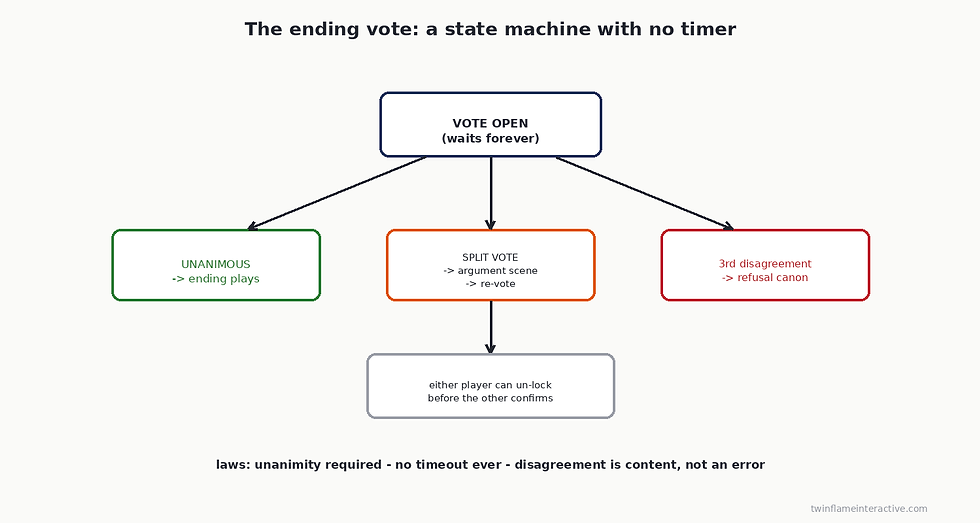
The spec that makes it land is a state machine with three rules. Unanimity is required - the ending only fires when everyone agrees, so no one gets railroaded. There is no timer, ever - the vote waits forever, because the pressure should be social, not mechanical. And refusal is the hardest input: a persistent holdout does not lose, they steer the group toward a distinct 'refusal' ending that is fully authored, not a fail state.
The chart below shows the state machine: vote open, then unanimous agreement plays the ending, a split vote triggers an argument scene and re-vote, and a third disagreement makes refusal canon. Either player can un-lock before the other confirms, so the choice stays genuinely shared until the last second.
The state machine: unanimity required, no timer ever, refusal as its own authored ending. That is what makes an irreversible co-op choice feel owned instead of imposed.


Comments